Sunday, February 21, 2010

CAMELS IN AUSTRALIA. Day 12 of Crisscrossing Australia


OUR CAMEL, RINGEE


Excerpted from my book OUR SUMMER IN AUSTRALIA Amazon.com

Day Twelve. Alright, this is the last day of the journey, so, how about a desert sunrise camel ride, or more factually; a dromedary ride of the one humped type.

ALL ABOUT THE CAMELS. The camel ride was not at all an inane tourist attraction, and I came away with a great respect for these animals. They were very instrumental in the development of early Australia. Initially brought in from Northern India, they immediately proved their value in the hot and dry interior of the country. Able to travel for 300-400 km without water, while carrying five times their weight, they were ideal for tasks such as bringing water to parched miners and hauling large quantities of wool from ranches — some over a thousand from miles from the nearest port. They served as pack animals for expanding the railroads into the interior, and pulled wagons and carriages more efficiently than horses. Some camels have been recorded as going over 650km (400 miles) and two weeks without water. Their demands are small — they can graze on most anything, unlike the horse. They can even drink salt water with no ill effect. After six or eight days of steady work, they need a day’s rest, and then they’re ready to move on. When water becomes available they will fill up with a 100 or so liters, which they can swallow in just a few minutes. They have a long life, well beyond 25 years, if well treated. They’re noted for a discerning personality, for if they don’t like you they will soon let you know by biting or peeing on you. Yet they are very loyal, forming lifelong companionships with other camels and drivers, from which they don’t like to be separated. They are communal animals, and do best with several more camels around them.

CAMELS IN AUSTRALIA. The Australians soon learned it was better to employ drivers that knew how to handle these independently minded animals. They brought in hundreds of Afghans, or in strine, “Ghans,” (that actually were from present day Pakistan) to manage the growing herds. So numerous were the Ghans in the 19th century, one still occasionally comes across a 19thcentury mosque, such as the one I saw in Broken Hill; a poignant reminder of the deep faith of Muslims. Eventually, with the railroad, improved highways, and finally the automobile, the need for camels decreased, and they were turned loose into the vast interior wilderness. That was wonderful! What a great retirement home —natural habitat, no predatory enemies, and best of all, no drivers or work. The cameleers, now without employment and in an alien country, by and large returned to their homeland, but some descendants remain in the outback today.

Presently, Australia has more wild camels than any other country, exports live camels, and camel meat has recently been approved for export. The camel population is increasing, but so far there is no cause for alarm, as they have little harmful effect on the land, in terms of over grazing, or invading inhabited areas. There are no reliable figures, but one government estimate has about 600,000 wild camels enjoying one helluva good time out there!

NEXT POSTING: Our Camel, Ringee, and an amusing camel story.

Monday, November 30, 2009

AYERS ROCK/ULURU: CRISSCROSSING AUSTRALIA


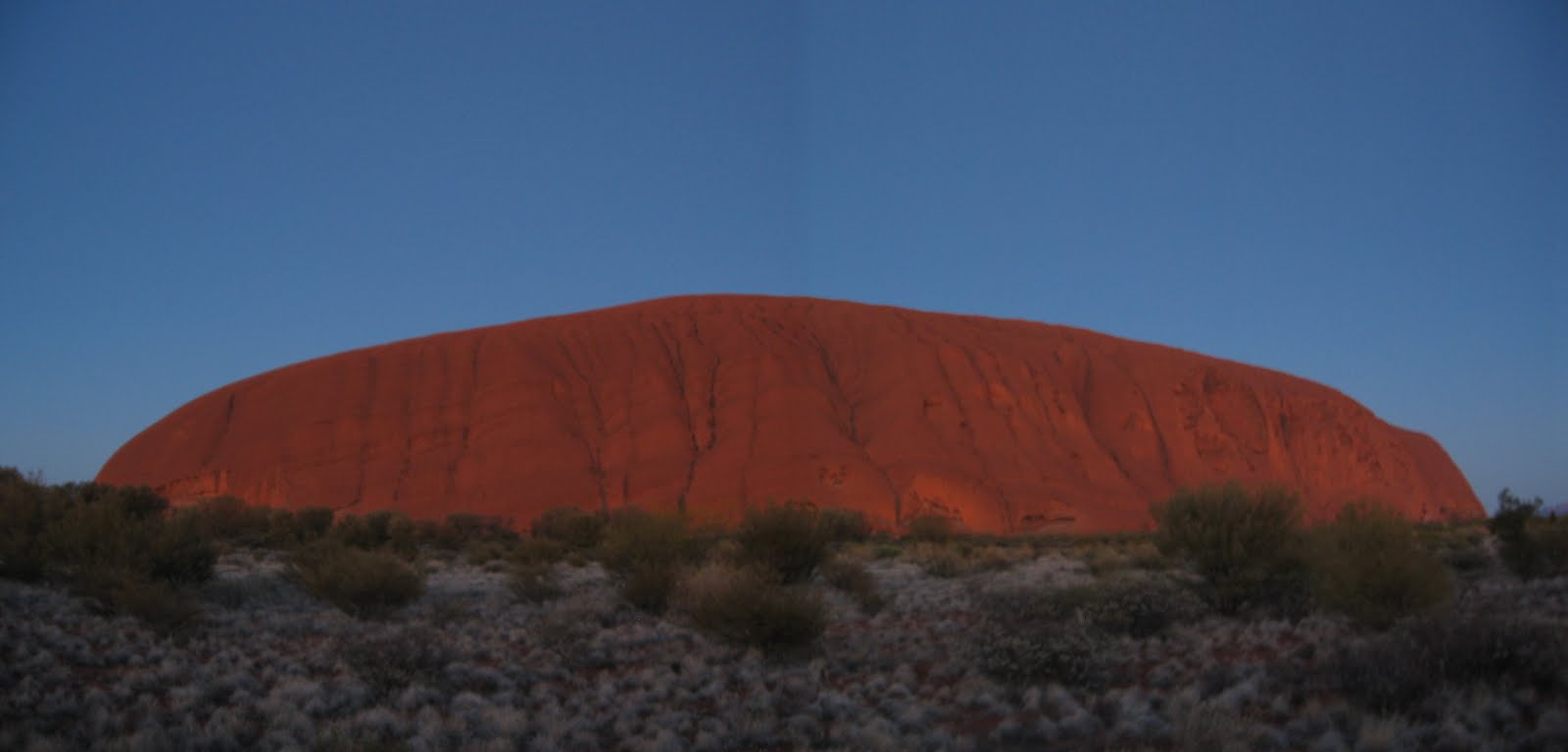
AYRES ROCK JUST BEFORE SUNRISE


AYERS ROCK AT FIRST SUNGLOW


AYERS ROCK RISEN

Excerpt from my book Our Summer in Australia & New Zealand: Amazon.com

Day Eleven. I had been looking forward to this day since first planning the trip to Australia. Climbing Ayers Rock at sunrise! It’s really not dangerous. Since records were kept beginning in 1960, there’s been only one fatality every two years, on average. Considering my life so far, those are very acceptable odds. The joke
going around is that the coroner’s report on the cause of death for people
climbing the Rock is, “death by lens cap” — another tourist dropped something halfway up the rock and forgot the warning not to chase it down. The Rock usually wins. Actually, what fatalities there have been are
from out of condition people (probably American) being overcome and suffering stroke, heart failure or heat prostration in the 115-125 daytime summer heat — otherwise known as natural selection of really dumb people who should not be out climbing The Rock. The indigenous people, the Aborigines, discourage climbing the Rock because of its meaning to them as a sacred symbol. However, for the present, it is still permitted, but perhaps not for much longer, as this is now Aboriginal property. So, today is my one chance. Another photo-op climbing something I shouldn’t. It didn’t work out! Nature interceded. The winds were too high that morning, and the park rangers didn’t want to bother with paperwork explaining what the coroner’s report meant by “got blown away.” While I spent the rest of the day reading Australian history, Elysee, who obviously is much smarter than me, in many ways, and deciding Australian history can wait until next term, spent the day in the heated swimming pool, which is why we were staying at the Lost Camel Hotel in the first place. “Good on yer Elysee.” All I have to show are sunrise pictures of The Rock, taken from about a half mile, which means, because of its size, some digital stitching a slight distortion. Sorry.

Saturday, August 29, 2009

AYERS ROCK-CRISSCROSSING AUSTRALIA


ELEGANCE IN THE DESERT

DINNER SITE OFTEN RELOCATED

SETTING SUN ON KATA TJUTA RANGE MILES DISTANT; NATIVE DIDGERIDOO PLAYING BACKGROUND "MUSIC".

(Excerpted from my book: OUR SUMMER IN AUSTRALIA AND NEW ZEALAND, AMAZON.COM)

Leaving Perth we were once more confronted with the vast emptiness of Australia. The flight from Perth to Ayers Rock is 2260 odd miles, crossing inhospitable terrain, devoid of a trace of Man’s civilizing mark. Frank Lloyd Wright pointed out how nature abhors a straight line. When flying over most of the world’s land mass you can see Man’s imprint below; fence lines, railroad tracks, housing grids, the shapes of ball parks and other geometric sports arenas, and not least of all, multi-storied buildings. Not so, flying over Australia. Within minutes of leaving Perth the
traveler can look down for hours upon nature’s uninterrupted handiwork. Dried riverbeds, long sweeps of red desert dunes, an occasional outcropping, and although they are down there, very little sign of man or beast. Landing at Ayers Rock, a government controlled park area, there are only a few choices of where to stay. On our first evening we attended a twilight dinner called The Sounds of Silence, some miles away in the desert from the complex center. This is an elegant affair, given the desert circumstances, with candlelight, champagne, tablecloths, native food such as kangaroo, emu and crocodile. The dinner site is continuously relocated to lessen any impact on the terrain. The fading light soon gives way to emerging stars. A professional astronomer gave a lecture on the Southern Hemisphere’s night sky,
as more and more nautical twilight faded. The enormous horizon-to-horizon night sky filled with evermore stars, and became strewn with the mist of the Milky Way. Fortunately for us, it was a moonless winter's night, the closest town being 275 miles away, and the desert devoid of air and light pollution. As the last light faded, and Mercury ascended over Mars in the low sky, telescopes and high powered binoculars were made available to further enhance viewing the magnificence of a sky we never see. The sky our grandparents took for granted. The meaning of, and how to read the Southern Cross was explained, Alpha Centurii our closest star was pointed out, and we were asked to hold all conversation and be completely still as we were enveloped by the sounds of silence. Again, to our good fortune, not even the slightest breeze imposed on the naked, soundless, starlit night. Along with all the wine you could drink… it was one hellava night.

Thursday, August 6, 2009

PERTH- CRISSCROSSING AUSTRALIA


EXAMPLE OF VERY VICTORIAN BUILDINGS-FREMANTLE


PANORAMIC VIEW OF MODERN PERTH FROM VICTORIAN HEIGHTS
(Excerpted from my book, OUR SUMMER IN AUSTRALIA AND NEW ZEALAND, AMAZON.COM
We finally made it to Perth! Crossed Australia from Sydney in a week. Now to upgrade and revel in the delights of this big city of 1.3 million. Ah,the Hyatt Regency, Club Floor for three nights. We arrived at 7pm and were being served complimentary cocktails fifteen minutes later, with enough canapés that dining out wasn’t even an option. “Winfield,draw our bath please.” Saturday morning in Perth, Western Australia. Beautiful winter day,clear skies and mid-day temperature about 19c, or 67f, with occasional showers lasting about ten minutes. Boats are out early on the Swan River that runs from Perth to its neighboring port city Fremantle, just 20 minutes away by car, or 45 by ferry. Perth was founded by the British in 1829, and has all the outward skyline appearance of a modern city, while in its heart George IV and Queen Victoria still reign in many of its streets and buildings, especially Fremantle. Like other Australian State Capitals, Perth is oriented towards the ocean and contains 1.3 million of the state’s 1.8 million population. This is a BIG State! Western Australia is a third of the continent, an area of one million square miles, and because of its west coast situation, more oriented towards Africa and Asia than the remainder of Australia. It takes less time to fly from Perth to Singapore than to Sydney. At one time, during the depression of the 1930s, Western Australia even voted for secession, but WWII changed that attitude. Fremantle, or "Freo" in 'Strain, was a major Indian Ocean port for US naval forces during WWII, with submarines taking advantage of its’ proximity.to Japanese shipping throughout the former Dutch East Indies, as well as a home base for US supply and transport ships. Tough duty for WWII! Here is a WWII sailor talking with his son. “Daddy, where were you during the ‘WAR’”. He answers, “Son, I was in the Pacific, in remote Western Australia. Nasty business, WWII, I’d rather not go into detail.” While on the subject of Fremantle, it became what it is one of Australia’s major ports,with closer proximity to Asian markets than Sydney because of C.Y. O’Connor, the same genius who brought the water to Kalgoorlie. Mr. O’Connor built a breakwater and wharf right into the Indian Ocean, where the Swan River empties, thereby creating the port and harbor out of nothing. Today, thanks to C.Y.’s vision, it is one of Australia’s major ports, loading large container ships with Western Australian products on a daily basis. C.Y. was quite a guy, (even if he did take his own life) and a life size statue of the man himself looks out over his creation. Oh yes, in his spare time he designed and oversaw the building of Western Australia’s railroads.

Tuesday, July 7, 2009

CRISSCROSSING AUSTRALIA- A WINE STORY


ALTHOUGH NOT FROM THE MARGARET RIVER AREA, TWO EXAMPLES OF EXCELLENT WINERIES

Excerpted from my book OUR SUMMER IN AUSTRALIA AND NEW ZEALAND, AMAZON.COM
From Point Leeuwin we picked up the pace to the Margaret River region, visiting a
newly opened winery looking very similar the new large “industrial” wineries built recently in California. It was there I confirmed my long held notion that the ubiquitous Australian wine Shiraz was actually Syrah, “flowing,” under different colors. I had to convince the winery guide, who was not accepting my assertion.
In Australia, as in the United States and most other countries (except France,) wines
are sold and labeled according their grape, not their region of growth. Thus, Chardonnay,Merlot, etc., rather than Bordeaux or Burgundy. The situation in Australia, I pointed out to the winery officials, is that there was no grape named “Shiraz.” The grape Australians called Shiraz derives from the Syrah, native to France, and the grape for their great Burgundy label,Hermitage. The guides at the winery were having none of this, so I thumbed through their Australian reference book, located the section on the syrah grape, and was pleased to find there was not only confirmation, but documentation on how Shiraz came to replace Syrah.
The book revealed that the Syrah grape was brought to Australia in 1832 by James Busby, among hundreds of cuttings he gleaned from Europe, to determine their adaptability in Australia. A trial in Sydney’s Botanic Gardens proved the Syrah was very adaptable, and later notes by Sir William Macarthur, a wealthy and influential Australian, writing on Australian wine in the 1840s, referred to “Scyras as an excellent grape…a very hardy plant,produces well…” The reference book I was using brought home my point by adding, “Shiraz,an understandable Strinisation of Macarthur’s Scyras…” What Macarthur had done is what Australians do to this day, reconstruct the English language, speaking "strine," which in itself is taken to mean speaking Australian. So that’s the story from where shiraz originates, and I am pleased to say that the winery guides took this “French Connection” of their Shiraz very well, and thanked me for adding this information to their discussion. No, they didn’tgive me any free plonk; which is strine for cheap wine. It’s very Australian to understand how they get plonk to mean cheap wine. In WWI French soldiers pronounced vin blanc, ordinary French white table wine, van blonk. Having heard Australians for several months I can almost hear them say this when I see the words. But what really makes it strine is when they simplify it altogether by saying simply, plonk. I don’t know how they get from “blonk”to “plonk”, but they do.

Wednesday, June 17, 2009

CRISSCROSSING AUSTRALIA: POINT LEEUWIN


WHERE OCEANS MEET. DESOLETE POINT LLEUWIN

We are about as far away from Sydney as one can get, during our crisscrossing of Australia. About 2,500 miles away. As far as from Boston to San Diego, but let me say that Point Leeuwin is no San Diego. This a point where the Great Southern Ocean and the Indian Ocean meet. It was named by the Dutch and noted by Mathew Flinders' sighting on December 7, 1801 during his historic circumnavigation of the Australian coastline. Flinders' mission-to survey the entire coastline of Australia-was conducted due to growing concern that the French, under Napoleon, were taking a greater interest in Australia, and soon might settle a colony, claiming part of the continent. It was Flinders who first suggested the name Australia from the Latin Terra Australis, or southern land. He proved definitively that New South Wales was not separated from what was then known as New Holland, and in fact Australia was a large, very large contiguous landmass. Unfortunately it was raining when we stopped in this most desolate of places and we were unable to get a photograph of the reknowned Pt. Leeuwin lighthouse. But what you see in the picture is what you get when you stop by. Rocks and ocean, period. As a French girl remarked to me about Australia, sometimes you are absolutely nowhere.

Saturday, April 18, 2009

CRISSCROSSING AUSTRALIA: SW AUSTRALIA & THE TREE TOP WALK


(Excerpted from my book OUR SUMMER IN AUSTRALIA, AMAZON.COM)

I hasten to mention here, as I should have done so when I began relating our cross Australia excursion, that our trip, including the train portion on the Indian Pacific, the Goldrush tours side trip to remote SW Australia, and the Outback stopover (future blog), was all put together with patience and a careful ear to our interests by Julia Lynch, of Adventure Tours and Travel, agent par excellence, in Coogee NSW near Sydney. "Good on ya Julia'.

So, leaving the whaling museum behind we now traveled to the far southwest of Australia just before the Southern Ocean meets the Indian ocean. There you will find a forest named the Valley of the Giants, containing groves of various species of tall trees the grow to heights of 250 feet or more, especially the Tingle (Eucalyptus Jacksonii).

These tree became increasingly endangered as a result of their popularity. The Tingle has a very shallow root system, and as visitors to the area increased, with improved roads and more local resorts, the trees were beginning to show the effects of countless footsteps around their base. One particularly large tree, whose hollowed out base was a favorite photo-op, finally gave in and collapsed in 1990. Something had to be done.

Dr. Syd Shea, who headed a government land management office, had seen a tree top walk while visiting Malaysia. A call was put our for proposals to build a facility along the same concept, the resulted in the brilliant Treetop Walk design. This is a construction of about 1800 feet in length and 120 feet above the forest floor. This ideal solution, allowing thousands of visitors to witness the forest without setting foot on the forest floor is as splendid as it is exhilarating. Elysee and I were fortunate to be there mid-week, off-season, on a slightly rainy day, thus having the area almost to ourselves.

The walk is not strenuous with an incline 1:14, with no steps. The pathway does sway slightly, adding an air of adventure. But even a casual observation of the construction reassures you that there is no danger. The design seems like a reverse of the suspension bridge with the stress downward on the arch. The perspective of casually walking along looking down into the forest is so unusual and at the same time relaxing, that the idea is being studied for other forests, as in Perth. It is a long way to travel, but if you are anywhere near SW Australia, Manjimup, you must do The Tree Top Walk.

Photos: Elysee and I standing inside a large Jacksonii. The hallowing out occurs naturally.
Two photos of the walkway.