Friday, November 7, 2008

ACROSS AUSTRALIA BY TRAIN: DAY FOUR


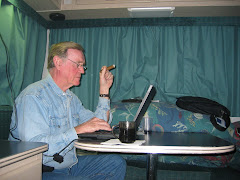
Re-boading the Indian Pacific to begin the run across the barren plain if the Nullarbor.
The conductor had given us a stern warning not to wander too far while in Cook, for once the refueling was complete the train would be leaving for it journey across the Nullarbor, and you don't want to be stranded in the middle of the outback. The Nullarbor (Latin in a way null being none arbor trees...i.e. treeless) is akin to California's Death Valley, but much larger in size. The Indian Pacific travels through this 160,000 square mile arid and treeless plain on the longest straight stretch of rail line in the world; not the slightest deviation for 286 miles. For train rides this is the longest day; a journey where the next meal becomes the highly anticipated event. Bring a good book. I dallied most of the day doing just that, reading the Fatal Shore, about Australia's convict experience; and talking with fellow passengers, mostly Australian, who were, fortunately, the type to make this trip an interesting experience as well.


At about 8pm, we arrived in Kalgoorlie, the site of a historic and immense gold field, and a mile stretch of the world's most expensive real estate. We left the train here, about 500 mils short of its pacific coast destination Perth. If you stay on the train overnight you arrive mid-day on the forth day. Instead we stayed the night in Kalgoorlie, joining a five day bus tour to the far south of Australia along the south sea road, and the Bight of

Australia, then turn north along the Indian Ocean and enter Perth by the "back door", via the Margaret

river wine country. Next I will tell the story about Kalgoorlie, Irish Luck, a US President, and the world richest mine.

Monday, October 13, 2008

ACROSS AUSTRALIA- DAY THREE ON THE INDIAN PACIFIC TRAIN

The hospital tried to stay alive by asking people to get "Crook" sick in Cook
In its "heyday" it cost $3 to play the nine holes. In 100 plus degrees?

After travelling all night from Adelaide we were awakened at 7am in time to prepare for entering the metropolis of Cook; population two. Cook was a town of 300 as recently as 1998; its sole purpose to service the National Railroad. The town boasts a school, swimming pool, hospital, post office and railroad service yards. It even has a golf course without a single blade of grass; a true links course with packed sand greens. The hospital had so little business that amid concerns about being closed by the government, people stopping over on the railroad were encouraged to "...get crook on Cook." (Crook being 'strine for sick).

When the government decided to get out of the railroad business in the '90s, privatizing its interests, Cook became an instant ghost town -an example of how changing government policy can have trickle down consequences.

Today Crook is used only as a changeover point for locomotive drivers, and a refueling stop after a long night run- just before the train starts to cross the Nullibor. This is the only reason we had a chance to stretch our legs. There's no platform, and steps have been placed at the exit doors. The conductor gives us all a stern warning not to cross the tracks, as passing trains in other directions likely will not slow down.. And above all be ready to board when the whistle blows- there are no overnight accommodations in Cook. Not a more desolate railroad stop in the world, with summertime temperatures about 155 degree, and a single digit of annual rainfall. We tried to find some remains of the golf course, but the site could not be distinguished, nature having taken it back. In a few more years there will be little left of this lonely reminder of times past.

Wednesday, October 1, 2008

Across Australia- Day Two on Indian Pacific Train

Sunday was spent between Broken Hill and Adelaide looking out at mostly barren plains.
That is when one isn't enjoying the lounge car. The bar is behind Elysee in the background.

Leaving Broken Hill mid-morning out train passed through mile after mile of flat bush country devoid of habitation and enterprise. After turning south towards Adelaide there is sufficient annual rainfall to allow viable agriculture. For the last 200 miles you pass through large wheat farms of 3000 acres or more, grazing cattle and many vineyards. We are in the state of South Australia, and Adelaide is proud to have been the first to seriously develop a wine making industry. Today South Australia leads all other states in wine production. Adelaide also leads Australia in automobile manufacturing, and is generally prosperous in many other areas besides agriculture.
Adelaide was settled in 1836, greatly expanded after the great gold rush of 1851, and the center of the city bears the markings of a wonderfully preserved Victorian city. An interesting tale.

Adelaide's main street is King William Street. When the King agreed to have the street named after him, he gave permission provided no street named after a commoner would cross his. This became no small problem as side streets were named after early settlers. Since there were a lot more of them than Kings the problem was solved by a cross street proceeding up to King William Street with one name and continuing on the other side with name of someone else. Ingenious!

We only had about six hours in Adelaide, took a city tour, and left about 6:30. Unfortunately, I left my camara on the train, so no pictures of beautiful Adelaide. Reboarding the Indian Pacific for a long night's journey north, then west along the barren plains. Dinner once more in wonderful period dining car and then off to the lounge car. Great way to travel. I highly recommend it.

Friday, September 5, 2008

Royal Flying Doctor Service

Beech King Airs equipped as ambulances. One is always on standby.

We are still in Broken Hill, stopping over on our cross country train ride aboard the Indian Pacific. That chilly Sunday morning the good people who run the Flying Doctor's Service were good enough to get out their warm houses and give a lecture and tour of this famous Australian institution. RFD's story is unique to Australia. Started by Rev. John Flynn of Queensland, in 1928, to bring emergency medical service to remote outback areas where there were only two doctors in over 2 million square miles. The operation we visited in Broken Hill dates back to 1938 and is entirely voluntary. It is free to patients with revenue coming entirely from donations. Today RFDs cover about 80% of Australia and treat about 160,000 people a year, conducting 17,000 evacuations from 16 bases.

The first RFD was organized in the Queensland town of Cloncurry, where there was a pioneer airline called the Queensland and Northern Territory Aerial Service., Quantas. Yes, that is the origin of Quantas Airlines. Not even many Australians know that. Gee whiz!

Sunday, August 24, 2008

Overnight to Broken Hill

A deserted Broken Hill on a cold mid-winter Sunday morning

Taking the second seating at breakfast we were in no hurry to leave the train. We had arrived at Broken Hill about 7:30 in Sunday morning, and the town was very quiet. Broken Hill had been a gold mining town for 120 years, and the story goes that more gold has been taken out of that operation during that time than anywhere else in Australia. It is estimated that from the 1880s to the 1950s about a billion dollars in gold came from the mines every year. That is BIG money. The mines are still a private company so the books are not publically available. If you have heard of the British mining company BHP, the largest in the world today, it got its start as Broken Hill Properties and has made many a Brit rich. Unfortunately, being Sunday, and a nippy one at that high on the plains in mid-winter, there was not much going on. Despite the wild west feeling, the town was deserted.

Saturday, August 9, 2008

Gold Kangaroo Dining Car

What the romance of the rails was all about.

We left the station around 3:30pm and after getting settled into our compartment, where Elysee informing me I had the upper berth, we made our way to the lounge car for pre-dinner drinks and to meet some of our fellow travelers. It was already lively, as you do not have to wait long for Australians to create a holiday spirit.The dining car was terrific. A throw back to an era long gone, and the food and service were all one could expect. Lots of wine, too.After dinner back to the lounge car we met a New Zealander on his way to Perth, Bob Dansey. It was not long before we were invited to stay with him when we got to New Zealand, and sure enough, some months later that happened.Regarding sleeping on trains. For me, the romance quickly faded. Its like sleeping in a giant cocktail shaker, and every once in a while you get poured out. The allusion to imbibing isn't accidental. A solution to sleeping well on trains is to to be amply "fortified" before turning in.

(Much of the above is from my book Our Summer in Australia and New Zealand which you can read on my web site links at www.marshallpublications.com)

Thursday, August 7, 2008

Train Across Australia

E Elysee invites you to board. The Wedge Eagle is the train's
Mascot with a wingspan of nine feet
Very comfortable compartments
One of the advantages of staying for an extended time (in Australia we stayed for three months) is the ability to plan any excursions to meet your schedule, and design an itinerary to suit your interests. We planned and took a twelve-day journey across the continent from Sydney to Perth and back, with many stops along the way. I'm going to begin with our embarkation from the Sydney train station aboard the Indian Pacific. That train makes the three night, 2700 mile journey, stopping along the way at Adelaide, and crossing the 160,00 square mile Nullabor Plain, one of the most desolate places on earth. But I'm getting ahead of myself. We were ticketed for Gold Kangaroo service, a first class ride with sleeping compartments, a wonderful period dining car and a private lounge car with a full service bar and a smoking room for those who still do. All A'board. Come along with Elysee and I, and ask any questions you may have.


(There is more on my website http://www.marshallpublications.com/)